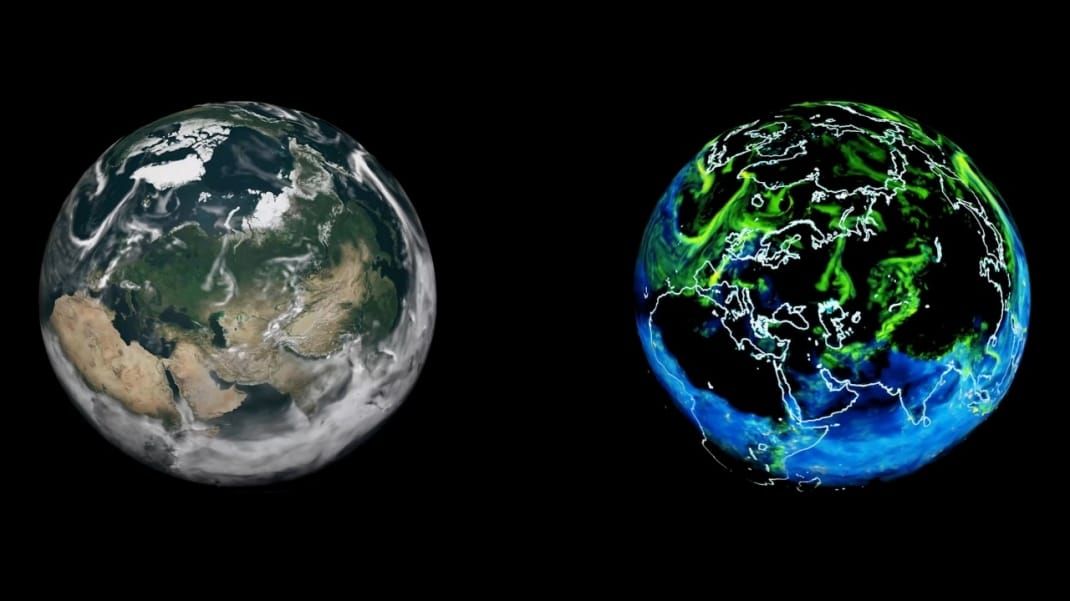
This week, NVIDIA formally introduced Earth-2, an AI-accelerated climate and weather modeling platform designed to run high-resolution environmental simulations at unprecedented speed and scale. Announced at the American Meteorological Society meeting, the system combines machine-learning models with physics-based simulation to generate localized forecasts, including short-term “nowcasts,” using significantly less compute than traditional numerical methods.
While Earth-2 is positioned as infrastructure for climate science, disaster preparedness, and energy planning, its implications extend well beyond meteorology. For designers, architects, and creative technologists, Earth-2 reframes simulation as an active design medium rather than a downstream analytical tool. Unlike conventional climate datasets—often static, coarse, and retrospective—Earth-2 operates as a continuously updating model of environmental behavior. This enables iterative testing of scenarios at the scale of neighborhoods, coastlines, or regions, making climate conditions a live constraint within design workflows. For practices working in parametric architecture, responsive urban systems, or environmental visualization, the platform signals a shift toward climate-informed form-finding driven by near-real-time data rather than historical averages.
Earth-2 also marks a broader evolution in NVIDIA’s strategy. Building on the logic of Omniverse and digital twins, the company is moving from simulating discrete objects and spaces toward modeling interdependent planetary systems—weather, infrastructure, energy, and risk—within shared computational environments. The result is a form of simulation that increasingly overlaps with governance, planning, and policy.
The critical question is not whether these simulations are more accurate, but how they shape decision-making. As platforms like Earth-2 become embedded in planning and design processes, they quietly establish defaults: what variables matter, what futures are modeled, and which risks are rendered visible—or ignored. Earth-2 is not just a forecasting tool. It is a signal that planetary simulation is becoming a foundational layer of contemporary design practice.