Interactive Digital Narrative research has long organized itself around a foundational assumption: that agency is legible, that participation is traceable to decision points, and that the interactive subject is, above all, a choosing self. Branching structures, dialogue trees, and procedural story paths all instantiate this assumption; they are design forms built for a participant understood primarily as a cognitive agent selecting among predetermined possibilities. That assumption itself requires examination. Drawing from practice-based research in choreography, digital art, and immersive media, narrative meaning in interactive systems can emerge through movement, sensation, spatial interaction, and environmental response, through the body's enacted presence within a responsive field, rather than through the exercise of discrete choice. The concept of choreographic systems, developed here as both a critical framework and a design paradigm, affords a model of interactive narrative in which stories are not selected but performed, in which the participant is a co-author whose bodily engagement with a responsive computational environment generates narrative coherence as an emergent, relational phenomenon. Situated at the intersection of performance studies, Human-Computer Interaction, and computational creativity, consideration should be made for understanding agency, authorship, and narrative design adequate to the full range of what interactive digital narrative, at its most expansive, can be.
Theoretical Grounding
Choreographic systems propose a different ontology where the narrative is produced in the encounter between body, environment, and responsive computation. Building upon work like Merce Cunningham's decoupling of movement from narrative intention demonstrates that spatial and temporal organization could generate coherence without a story in the conventional sense. Choreography provides philosophical grounding for the claim that a participant moving through a responsive system is not supplementing cognition with action but engaging in a fundamentally unified perceptual-kinetic act that is the meaning-making process. The narrative, if we retain that word, is the trace of that encounter.
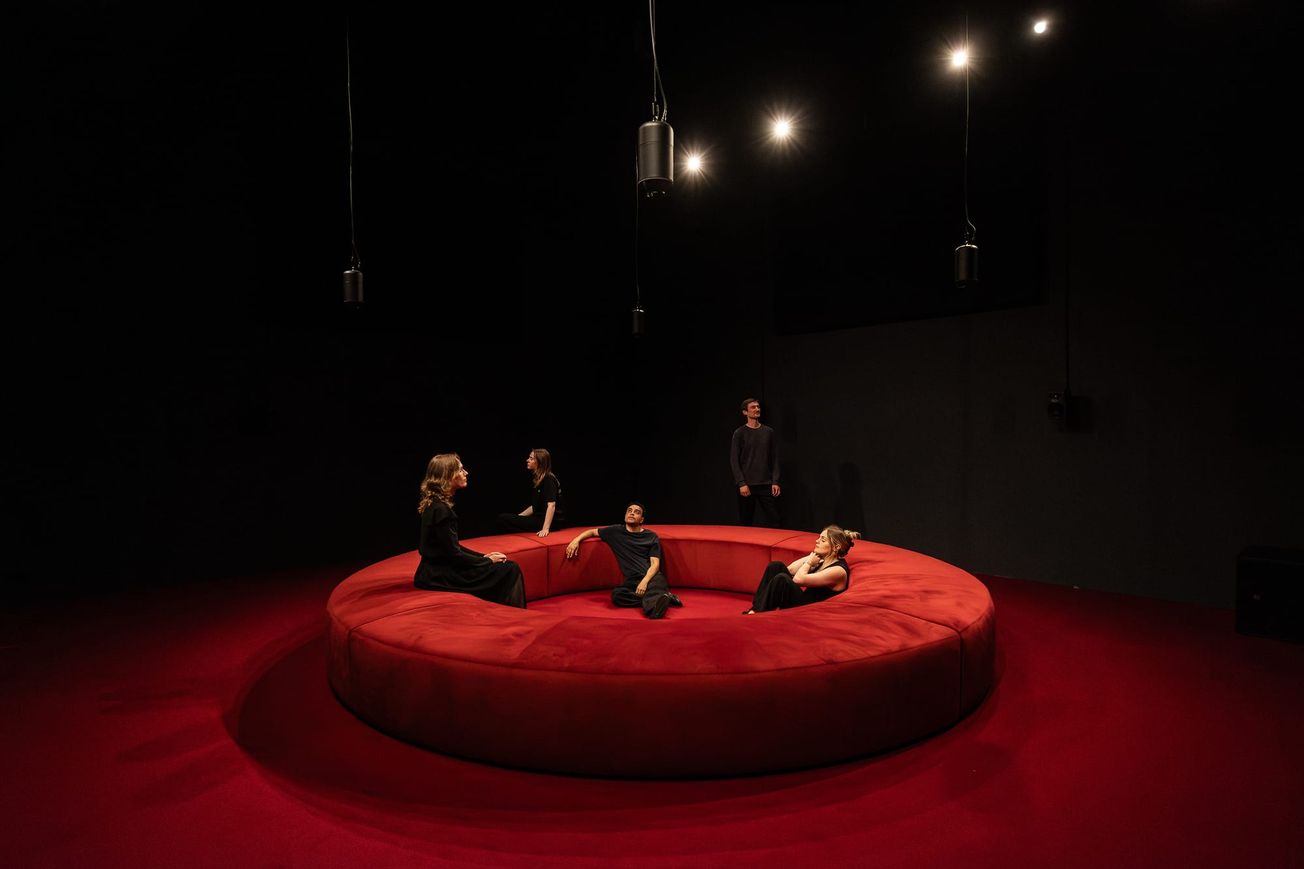
Siobhan Davies's Table of Contents is a significant example of physical engagement with a dynamic system. Visitors move through the space, handle physical materials, and trigger digital content through spatial proximity and gesture. The work explicitly refuses linear narrative in favor of association, juxtaposition, and physical encounter, replacing sequence and causality. The result is a form of narrative experience grounded entirely in the participant's bodily engagement with space and material.
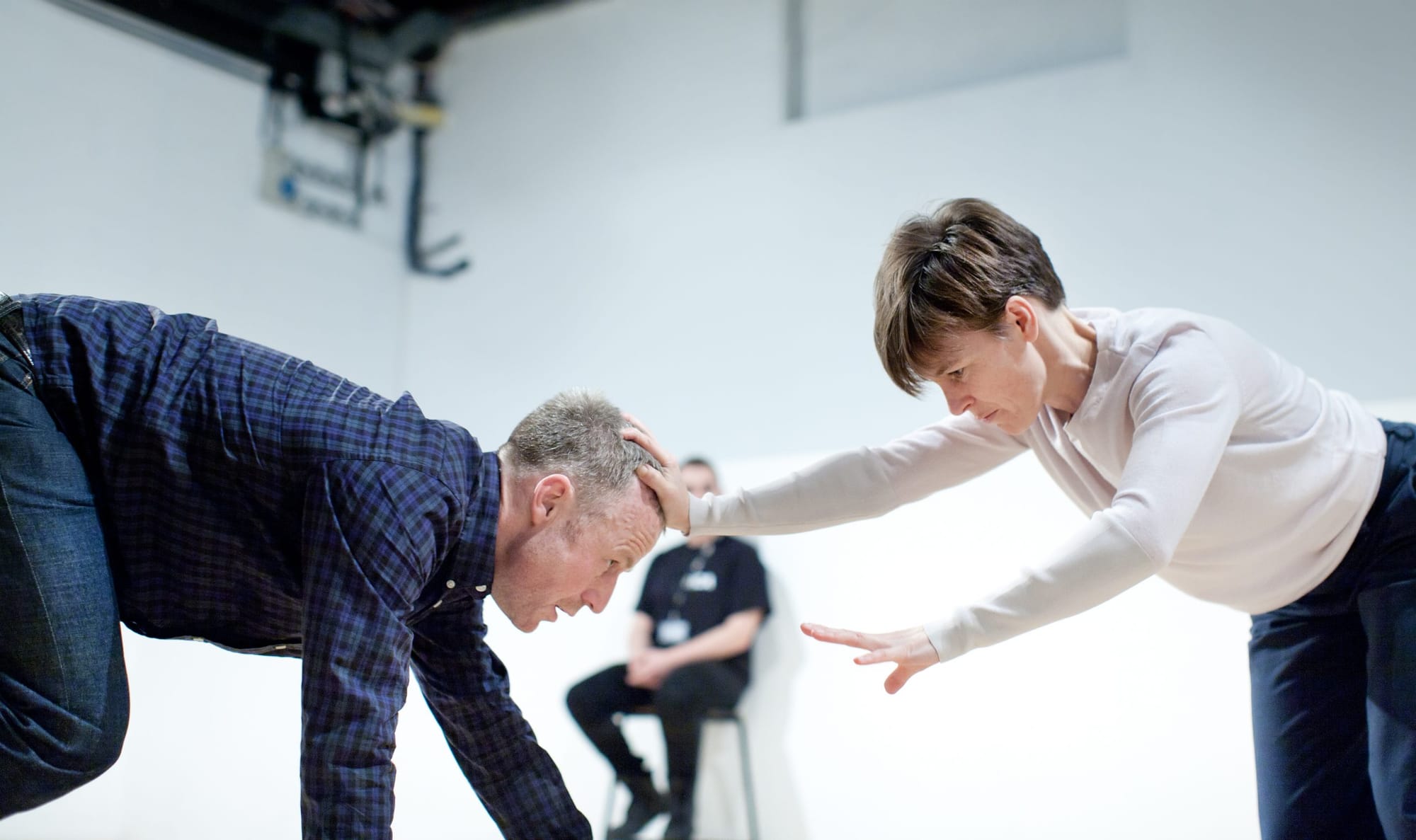
Narrative coherence in choreographic systems arises from the convergence of three forces; the participant's lived experience of movement, environment, and feeling; The system responds to participants in ways that help shape the experience without controlling it; and the space that changes based on how people move through it over time. By foregrounding duration as a form of agency, choreographic systems shift attention toward embodied participation and invite further consideration of how interactive digital narratives are designed, experienced, and assessed.
Embodied Co-Authorship: Gesture, Affect, and Emergent Narrative in HCI
Mainstream HCI has historically organized itself around a particular model of the human: a cognitive agent who processes information, forms intentions, and executes actions through discrete input devices. Opaque interfaces are designed for a subject understood primarily as a decision-maker and task completer. This framework is only a partial option. It produces interfaces optimized for cognition while systematically undertheorizing what the body does in interaction. Interactive narratives specifically are significant: systems designed within this framework tend to locate narrative agency in the decision, reducing the body to an instrument for executing choices rather than recognizing it as a medium through which narrative experience is constituted.
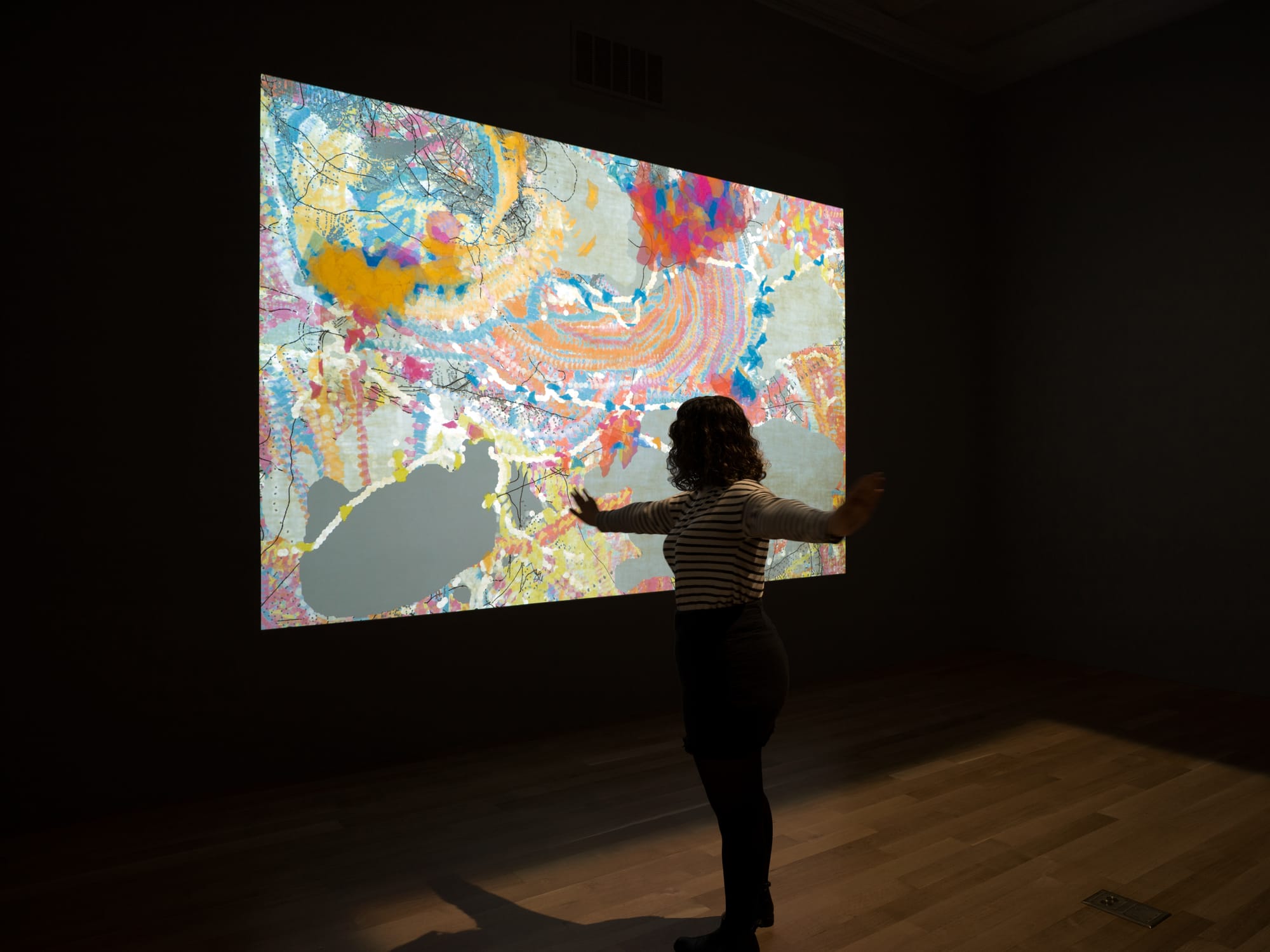
Camille Utterback's Precarious offers a precise counter-model: participants discover that their bodily presence and movement within the installation continuously destabilize and reshape a delicately balanced visual environment, such that narrative coherence is never achieved through decision but is instead perpetually negotiated through sustained physical attention and spatial commitment. The work makes legible what the cognitivist HCI framework renders invisible, and that the body's duration, weight, and relational attunement to a responsive environment are not supplementary to narrative agency but its primary medium.
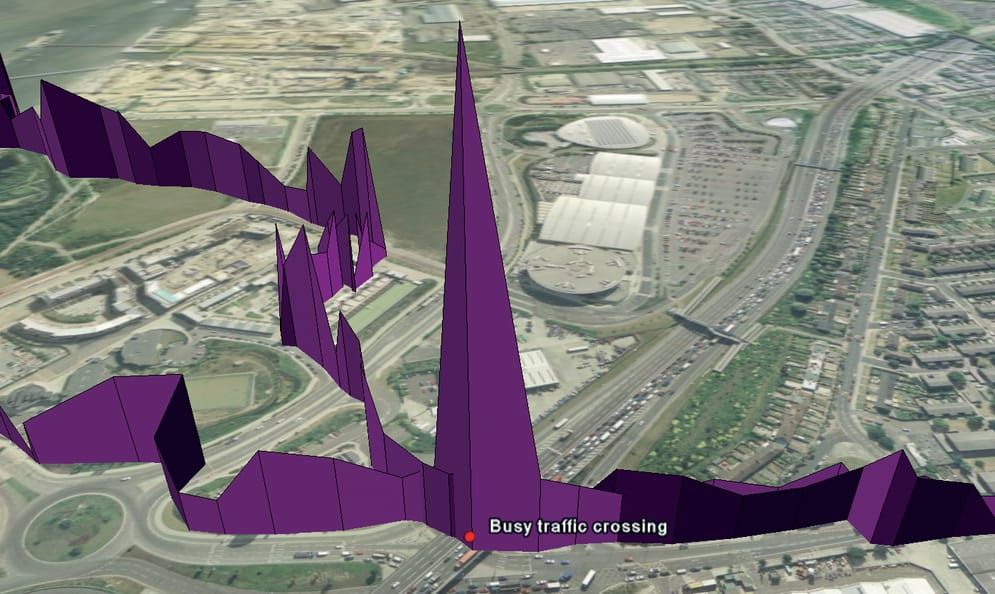
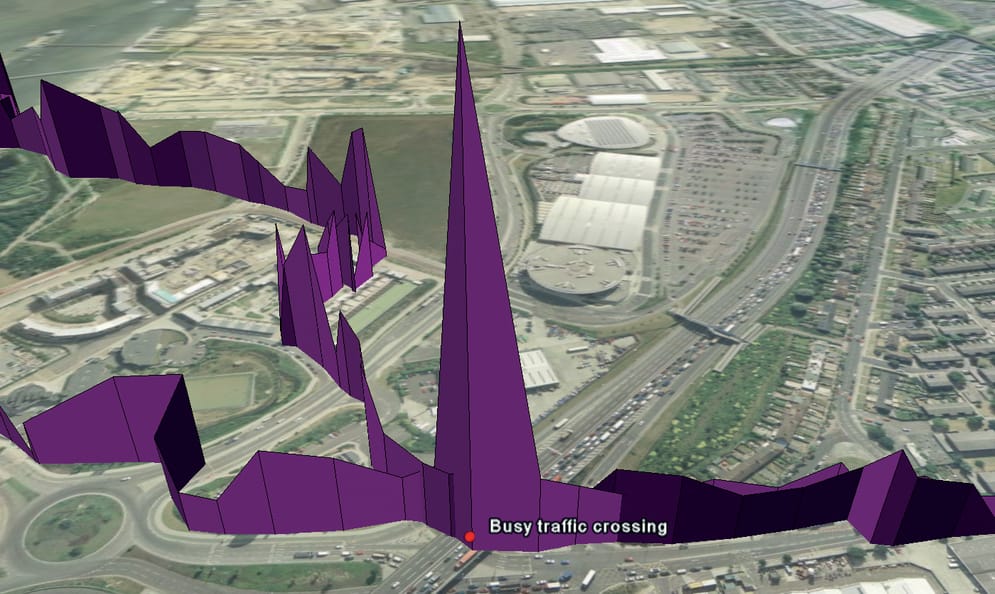
Christian Nold's Bio Mapping extends this argument into urban space, equipping participants with galvanic skin response sensors during city walks and generating maps in which physiological arousal is overlaid onto geographic terrain, producing affective autobiographies in which the body's involuntary responses to the environment become the narrative's authoring force. Bio Mapping makes visible that the body carries and continuously generates narrative knowledge that never passes through conscious decision, that the story of a person's embodied relationship to place is written in sensation first, and that computational systems designed to read and spatialize that sensation can make such stories newly visible without ever reducing them to choice.
Taken together, these frameworks propose a reorientation of both evaluative and design practice in embodied HCI: replacing structural coherence with relational coherence as the primary measure of narrative success, foregrounding affective trajectory, movement quality, and durational commitment as the fundamental units of interactive agency, and asking not whether a system tells a coherent story but whether the participant-system encounter generates a coherent experiential arc unique to that body, that session, that unrepeatable interaction. This reorientation shifts design from controlling narrative outcomes to shaping conditions for encounter. In Precarious, for example, the participant's movement continuously reshapes the visual environment, generating narrative through embodied interaction rather than predetermined story paths.
AI as Performative Collaborator
The most immediate contribution AI makes to embodied narrative is the capacity for genuine adaptation, systems that do not simply respond to movement according to fixed rules but learn the participant's movement patterns, preferences, and rhythms over time and modulate their responses accordingly. This transforms the interaction from a fixed score into a living one: the system becomes a responsive interlocutor that develops a relationship with the specific participant, generating narrative through the accumulation of that relationship over time. AI systems trained on physiological, gestural, and facial data can detect emotional states with increasing sophistication. Generative AI models can produce environmental responses of extraordinary richness and variety, ensuring that the responsive field never exhausts itself through repetition. AI systems with persistent memory can generate narrative development at a timescale unavailable to single-session interactive systems.
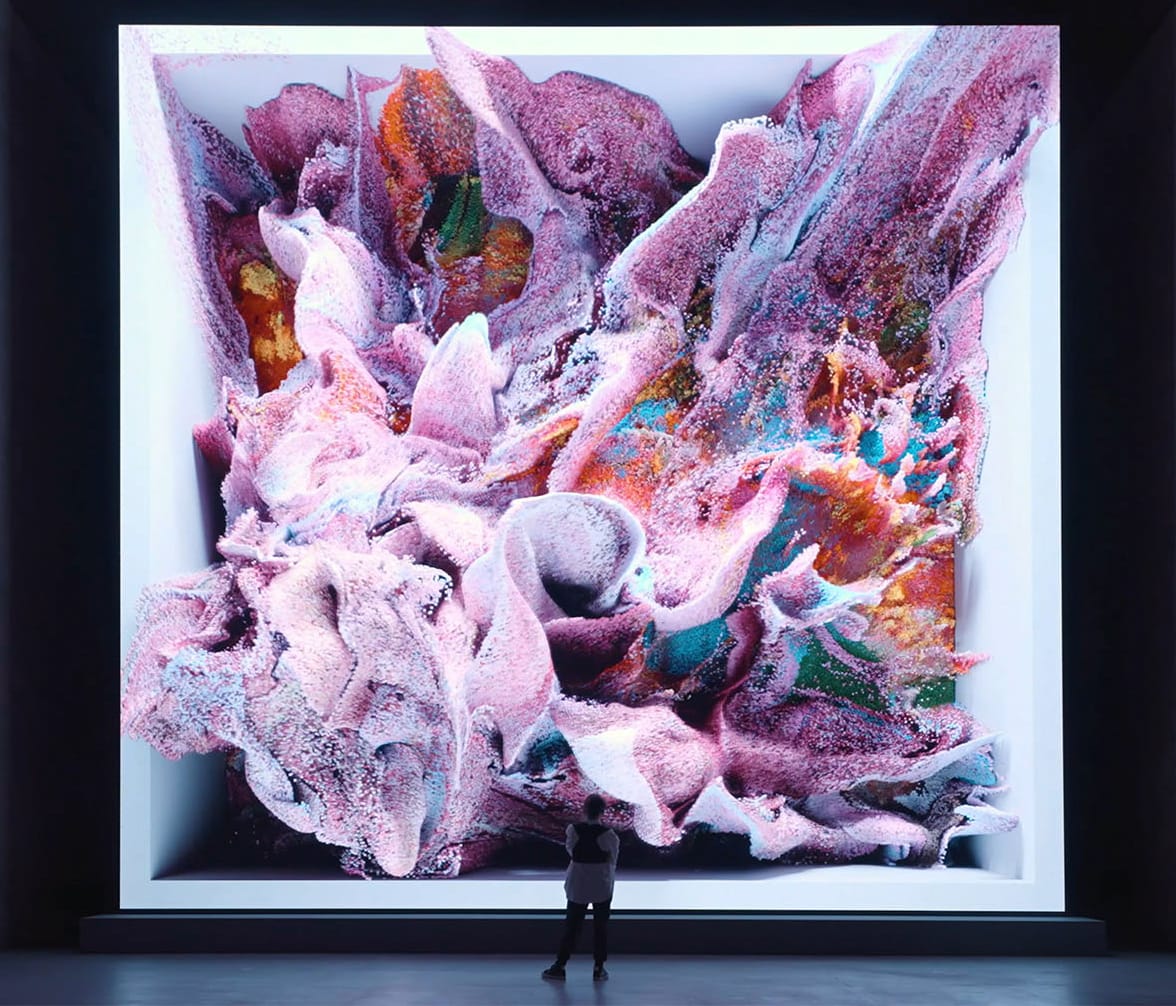
Unsupervised, by Refik Anadol trains a StyleGAN2 model on works from MoMA's collection to continuously traverse the latent space between them while incorporating real-time environmental inputs, including visitor movement, ambient sound, light, and weather to modulate its generative output. The work's interaction model is environmental and aggregate rather than individual and intentional: no single visitor controls it, no visitor is passive within it, and the narrative it produces has temporal shape, affective coherence, and developmental arc without authored sequence or branching structure. It demonstrates how an AI operating as a responsive possibility structure, rather than a predetermined storyteller, can generate narrative an experience of genuine depth through the continuous convergence of a participant's embodied presence. It can move us away from stories we process to ones that are felt.
Lynn Hershman Leeson's DiNA presents an AI-driven agent whose identity, emotional states, and conversational behavior evolve through accumulated interactions with participants over time, generating a narrative of relationship, one in which the participant's returning presence, shifting emotional register, and durational commitment shape who DiNA becomes. Unsupervised treats AI as an environmental system that generates many possible outcomes. DiNA treats it as a relational presence that develops with a specific participant. One explores an aesthetic field; the other builds an ongoing encounter. Both show that AI can act as a collaborator in shaping embodied narrative experience, not just an autonomous storyteller.
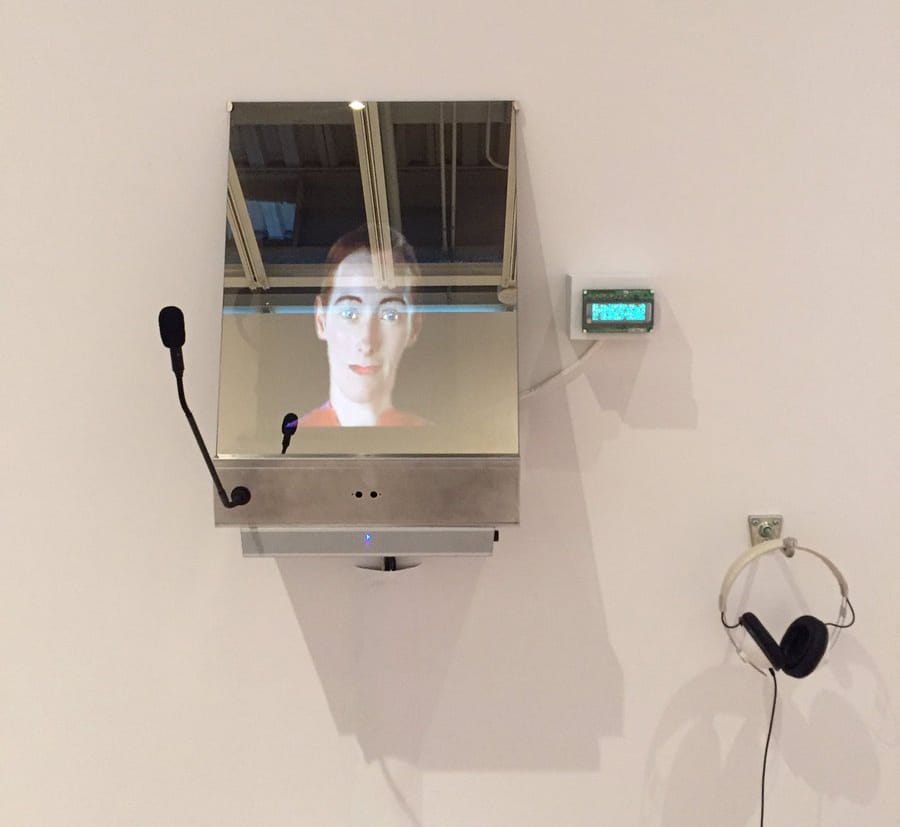
By integrating an AI system that can learn from the participant, the work will adapt its responses and genuinely change by the encounter, converting it into a co-protagonist in a story that belongs to both. This fundamentally reframes narrative authorship by locating the production of narrative within the evolving relationship between participant and system, where meaning emerges through their ongoing mutual transformation.
Consideration
The works and frameworks examined here collectively propose that interactive digital narrative has been working with an unnecessarily diminished model of both the human and the computational. These frameworks share a common claim: narrative emerges from what happens between a body and a responsive system, in real time.