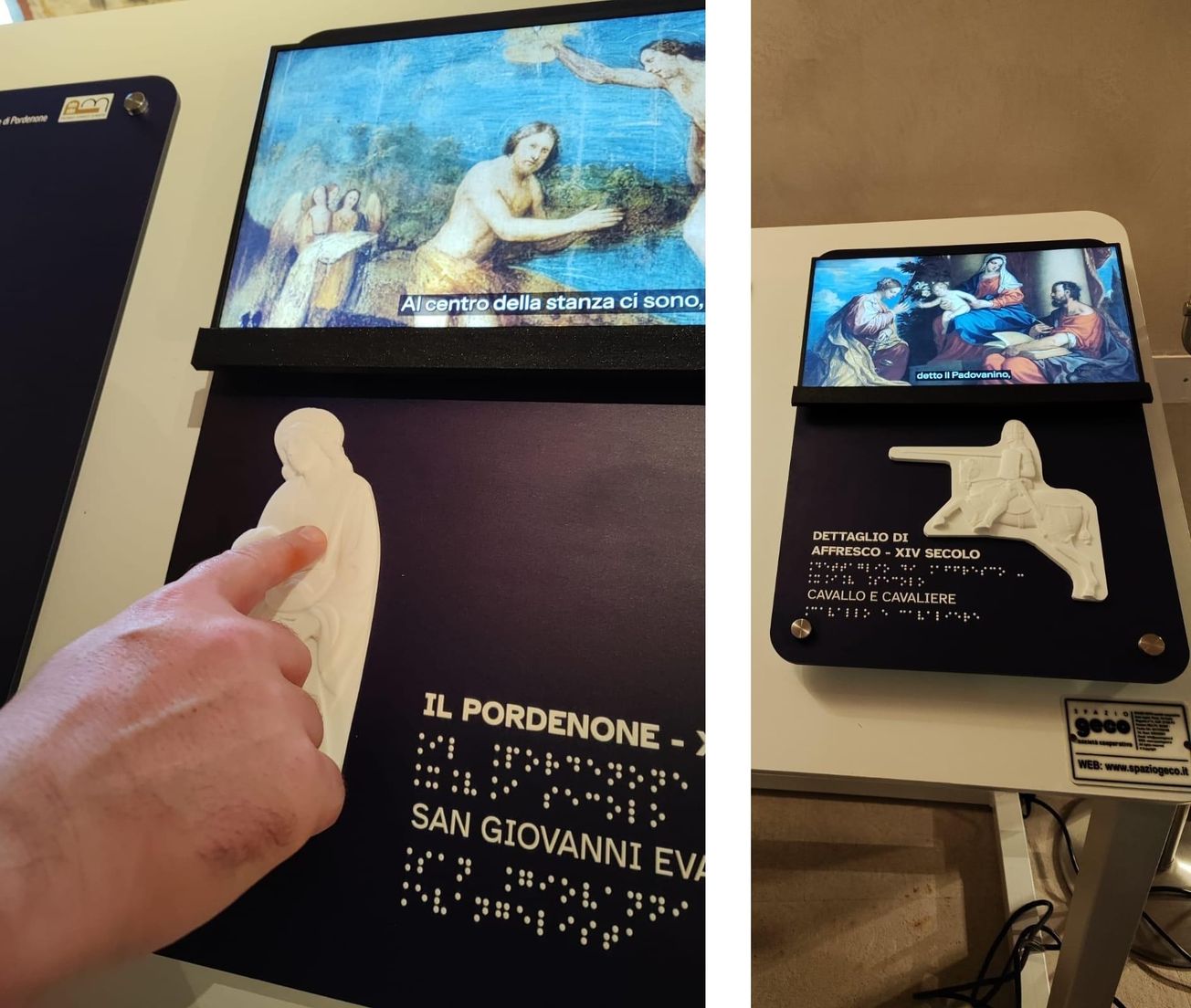
In our rapidly digitising world, the do-not-touch era of museums is fading as digital fabrication breathes vitality into exhibitions. On one hand, the diffusion of physical tactility, where 3D scanning, CNC milling, and 3D printing reconstruct interactive replicas, embedding information in various forms. On the other hand, digital interactions, particularly Internet of Things (IoT) and Generative Artificial Intelligence (GAI), play an important role in bridging audiences with showcasing objects. Fab Labs (Fabrication Laboratories) have emerged as the pivotal engines of this shift, bridging the gap between intangible digital archives and the sensory reality of the physical world. By functioning as multisensory incubators, these labs democratize access to cultural heritage, turning static objects into interactive tools for haptic learning.
Spazio Geco, a multidisciplinary FabLab in Pavia, Italy, a collective of 'digital artisans'—including architects, archaeologists, engineers, and art historians—pursues a new form of curating that blends cultural heritage data with technological soul. SpazioGeco employs a dual strategy to modernize cultural heritage. First, they use parametric design and digital fabrication to create standardized tactile maps and replicas, making collections physically accessible. Second, they embed state of the art technology to let artifacts "talk," providing audible and visible enhancements. This approach reimagines museums not as silent encyclopedias, but as dynamic, interactive laboratories where history is felt and heard.
From Tactility Standardization...
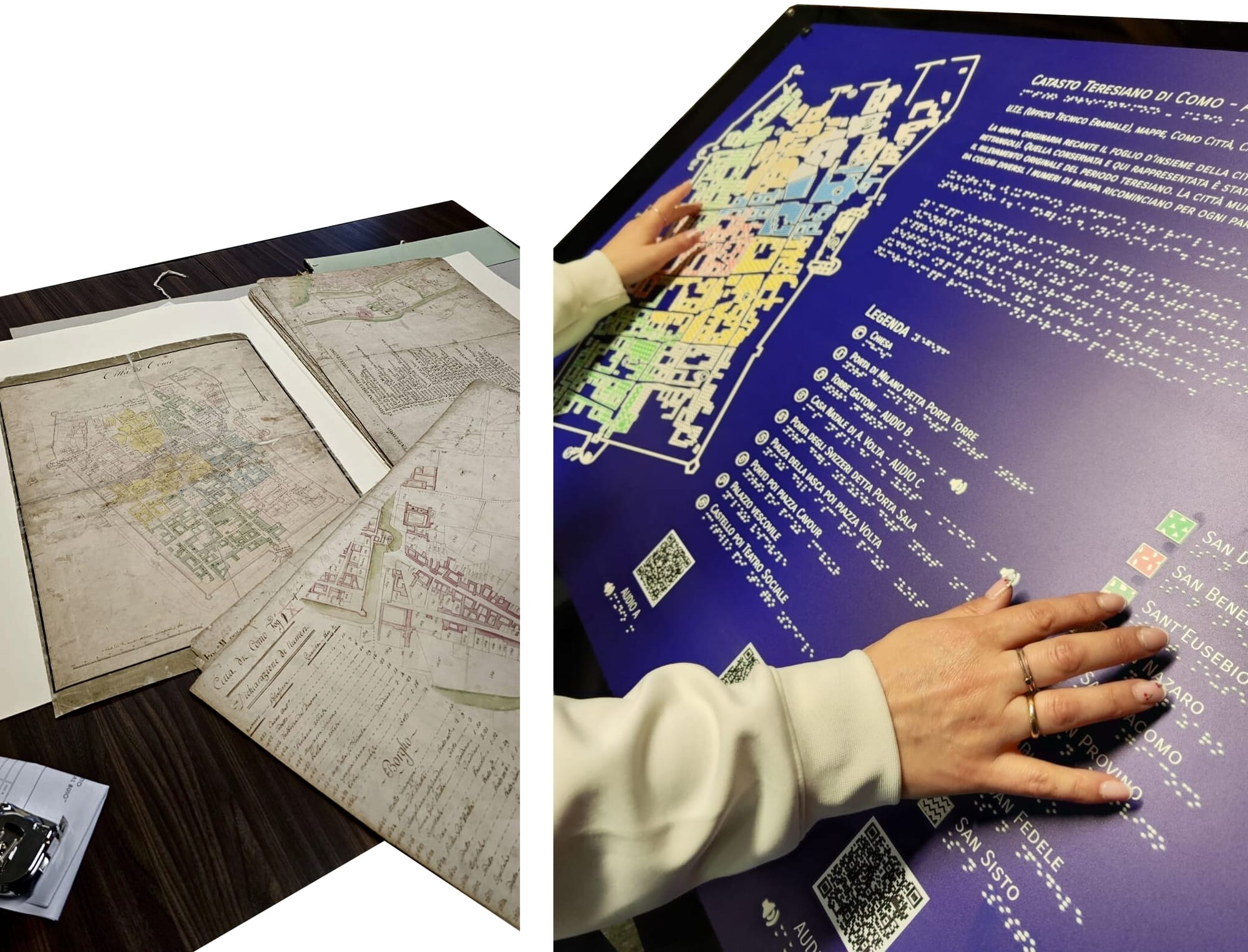
If you find yourself passing through Lombardy, you will discover a cadastral treasure under the names 'il Catasto Teresiano' or 'il Catasto "Carlo V"'. This is the Teresian land registry, from the desire of duchess Maria Tesera of Austria, an impressive cartographic work created between 1718 and 1760 which records the landscape and urban characteristics of the territory during the contemporary period. Many important Lombardian cities and towns were carefully traced and archived; one example is the map of Como, which is currently conserved at the State Archives of Como (ASCO). As the work has great historic and academic value, the challenge for the Archives when deciding to make it available to the public is clear: how to interpret the multi-level richness of the work in a two-dimensional graphic archive.
Taking the requirements into account, the team has decided to create an accessible, sensory experience based on the archiving material. One vital tactile map has been carefully measured and fabricated. The map has been 'translated' from material intended only for experts into a comprehensible reading for visually impaired people. The concept of 'reading' has been developed through diverse textures, symbols and tactile colours representing each land cover on the map. The tactile map's simplicity is blended with precise cartographic data, UV-printed on a metal sheet to form a harmonious and contrasting interpretation of the cultural heritage. The cherry on top is the QR code, which acts as a digital portal to podcasts containing relevant information and details of other works in the archives.
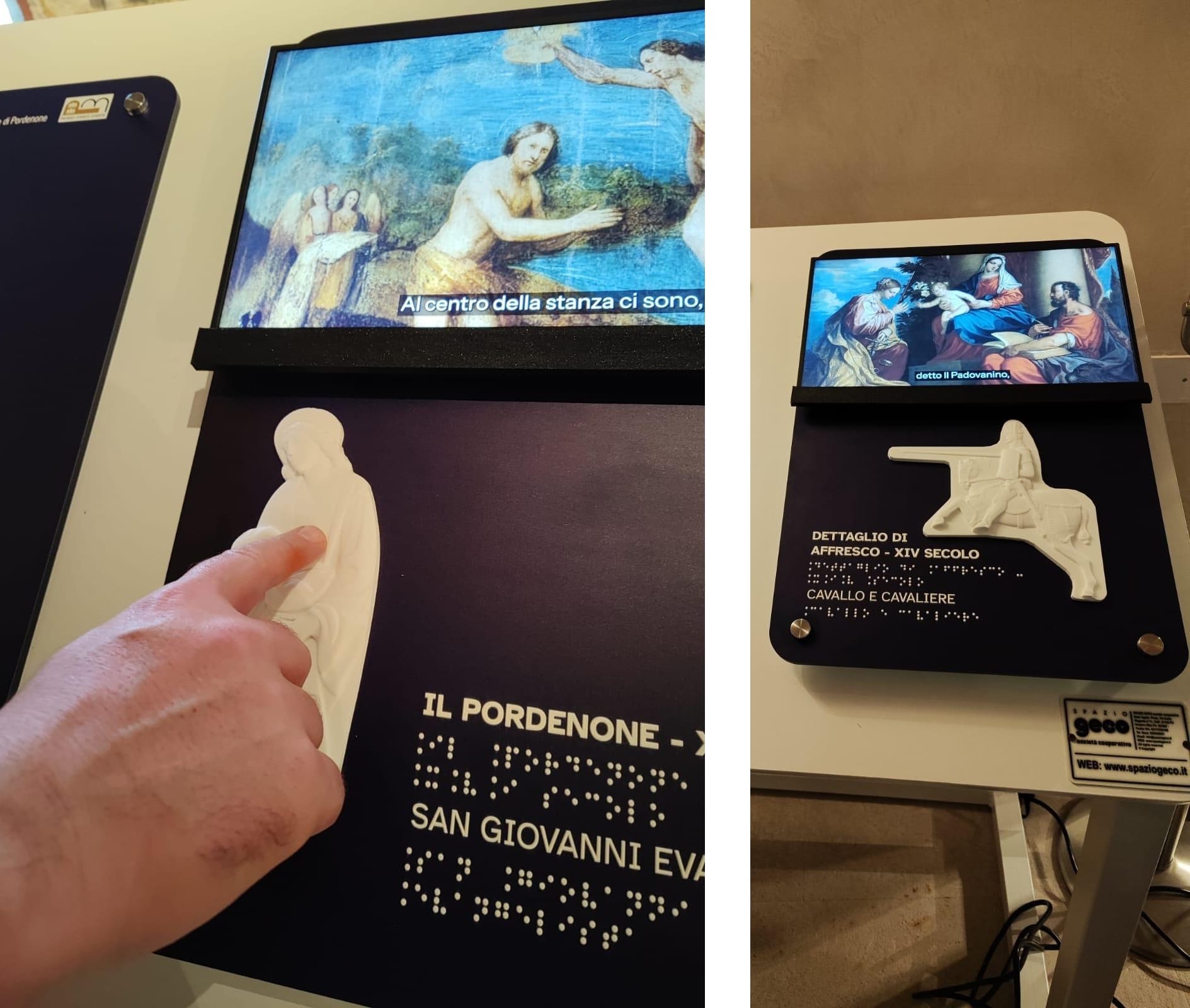
At this moment, we can ask ourselves if it is possible to reimagine abstract objects from disrupted paintings in a way that goes beyond visual impression and tells a story. At the Civic Art Museum of Pordenone (Museo Civico d'Arte di Pordenone), located in Palazzo Ricchieri in Pordenone, Friuli-Venezia Giulia, Italy, there are three 3D printed pieces illustrating three themes of the museum: architecture, religion, and medieval literature. The first piece depicts the façade of Palazzo Ricchieri, a medieval tower house that was transformed into a Venetian-style residence by the wealthy merchant family Ricchieri, thereby portraying the context of the museum. The next two are frescoes depicting Saint John the Evangelist under the Cross and the love story of Tristan and Isolde. One conveys the pain and despair of the death of Christ, while the other depicts the dynamism of the chivalrous duel from the original story.
… Toward Digital Exploration
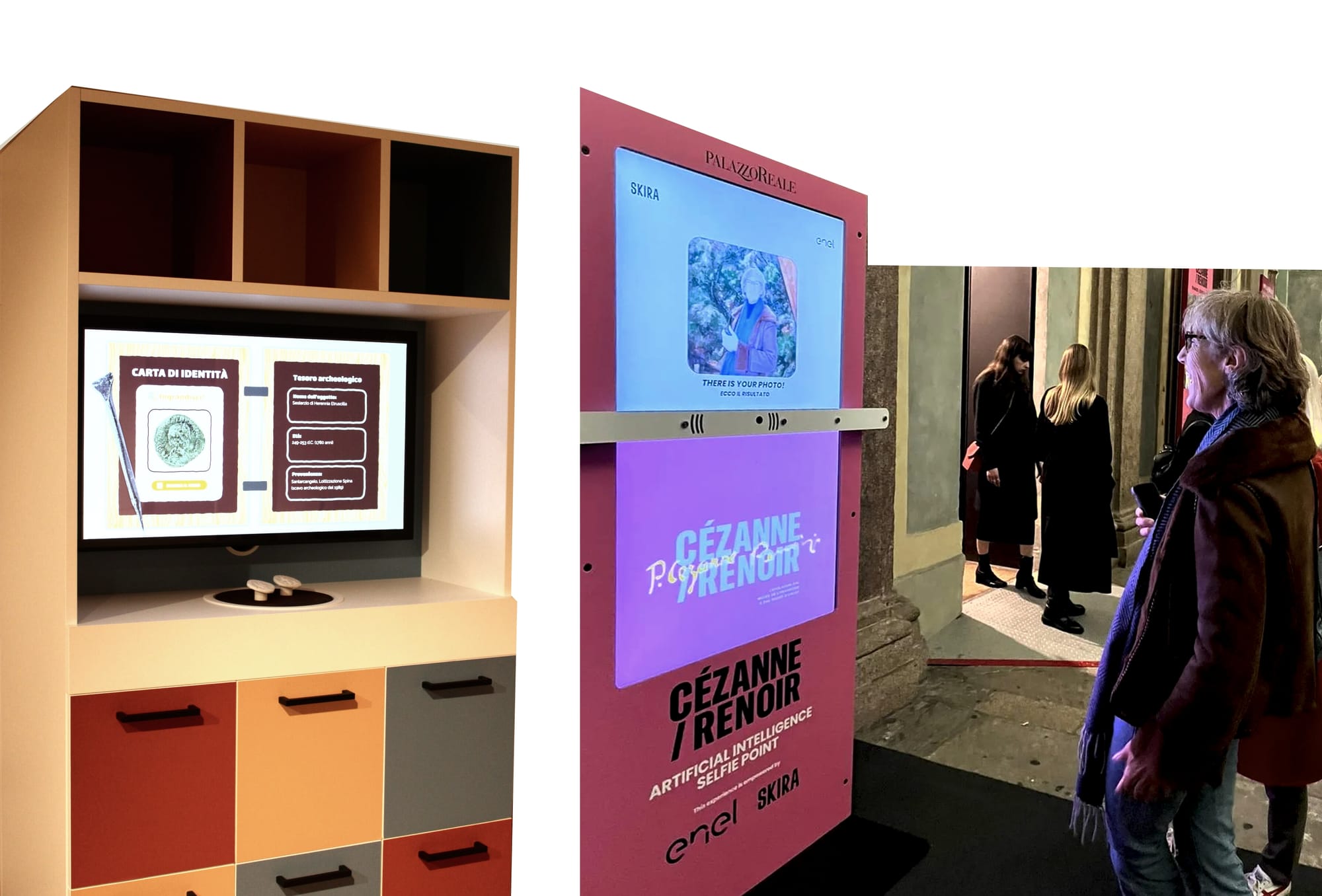
At the entrance of the exhibition Cézanne / Renoir at Palazzo Reale in Milan organized by Skira Arte, an gAI Selfie Point was installed to draw visitors into a playful, immersive experience — one that transforms passive observation into active participation. Users first select one of the featured masterworks as their backdrop, then choose whether they wish to be reimagined through the brushwork of Cézanne or the luminous style of Renoir — before snapping a selfie directly on the totem. An AI-powered trigger then processes the shot, seamlessly compositing the visitor's figure into the painted landscape and rendering it in the chosen artist's signature style. The interactive totem represents a forward-thinking approach to audience engagement: a digital experience designed to spark curiosity and lower the barrier of entry to fine art, while simultaneously communicating with the audiences.
Should a simple, AI-supported totem form in an artistic realm for its users, then a cabinet of curiosity that combines digital and physical interaction could be capable of engendering a similarly profound experience. This is exemplified by Wunderkammer 4.0, a device located at MUSAS – Historical Archaeological Museum of Santarcangelo di Romagna. Archaeological discoveries are typically meticulously preserved by experts and subsequently rendered as digital replicas. When exhibited in an appropriate setting, these replicas are capable of recounting their history through multitouch screens.
… And Beyond
The works of Spazio Geco leave us certain wonders of the blending of digital technology and cultural heritage. Digital fabrication aids represent a wide range of antiquities and works, from cartography to architecture and art, in numerous forms, e.g. 2.5D plane or three dimensional miniature. At the same time, AI and IoT breathe life into things, reconnect audiences and exhibitions through signals and digits. It is now time to imagine the future of post digital museums.