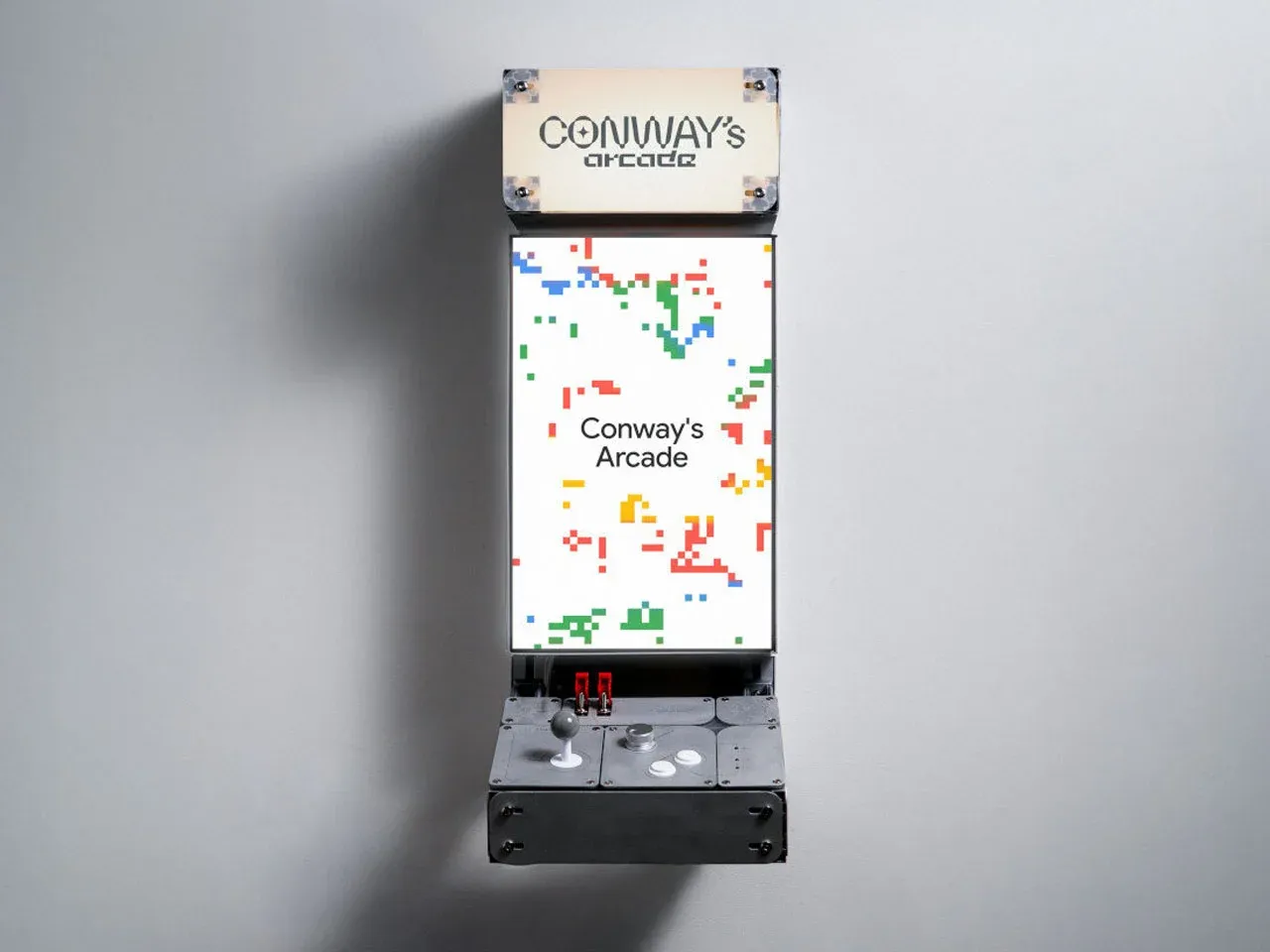
AI-Powered Conway’s Arcade is not a retro remake. Developed by SpecialGuestX and commissioned by Google, the project was presented at NeurIPS 2025 as an interactive installation that generates gameplay live rather than loading a fixed, preauthored title.
At first glance, the cabinet resembles a conventional upright arcade machine: joystick, mechanical buttons, compact footprint, pixel-style graphics. The difference lies in the software. Each session produces a distinct gameplay configuration in real time. Instead of replaying a static level, players encounter shifting arrangements of mechanics that echo classic arcade genres without replicating any single one. The project positions the arcade cabinet as a platform for exposing computational systems in action.
From Cellular Automata to Interactive Systems
The conceptual reference point is John Horton Conway’s Game of Life, the 1970 cellular automaton demonstrating how simple local rules can produce complex global patterns. In Conway’s Game of Life, cells switch states based on neighboring conditions. No central controller determines the outcome; structure emerges from rule interaction. AI-Powered Conway’s Arcade draws on this rule-based logic as inspiration. Rather than functioning as a conventional AI demo built around large-scale models or scripted scenarios, the cabinet generates gameplay configurations through structured rule interactions. Sessions unfold as dynamic arrangements of obstacles, agents, and motion patterns derived from this generative framework.
This approach distinguishes the project from standard procedural games. Traditional arcade software runs fixed binaries. Even procedurally generated titles typically operate within predefined templates and content libraries. Here, the emphasis is on recombining rule-driven behaviors at runtime, producing sessions that vary in structure rather than simply reshuffling assets. Players learn the system through interaction. Instead of following explicit instructions, they observe how elements behave within the current configuration. Patterns become legible through play.
Real-Time Variation, Legible Mechanics
Visually, the cabinet references early arcade graphics—flat color fields, geometric sprites, high contrast. The restrained aesthetic makes behavioral changes easier to register. When gameplay configurations differ between sessions, those differences are visible.
Individual runs may evoke familiar mechanics: paddle-and-ball exchanges, vertical obstacle navigation, projectile-based interactions. These are structural echoes rather than direct recreations. The system recombines recognizable arcade logics into new arrangements, producing experiences that feel referential without being fixed remakes. Because each session begins with a newly generated configuration, memorization alone offers limited advantage. Players instead attend to how movement, collision, and spatial constraints operate within the present setup. The cabinet foregrounds rule interaction as the primary site of engagement.
Hardware as Interface to Computation
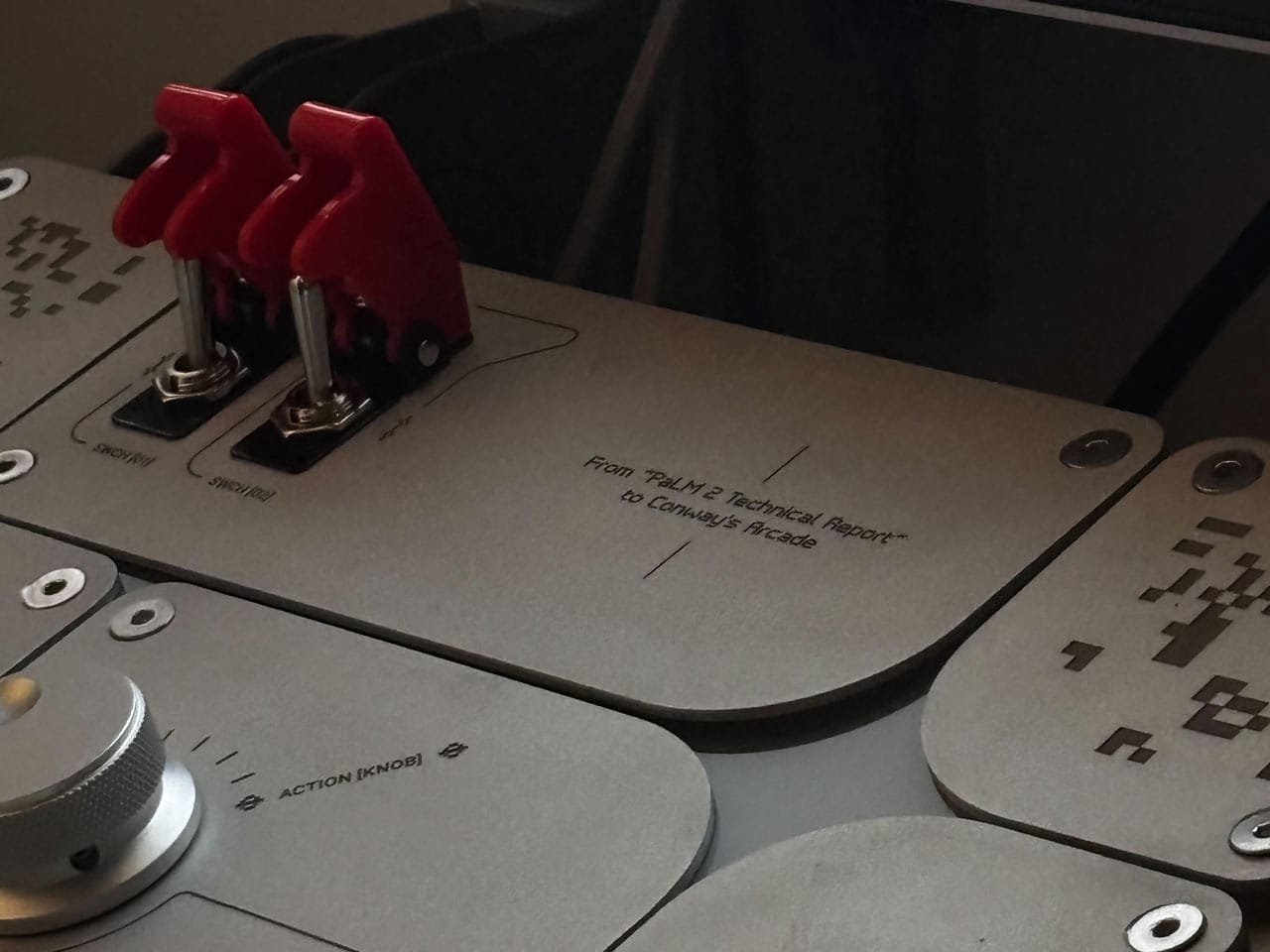
The installation is housed in a custom-built aluminum cabinet designed for transport and exhibition contexts, including its presentation at NeurIPS 2025. While engineered for mobility, it retains the proportions and ergonomics of a traditional upright arcade machine.
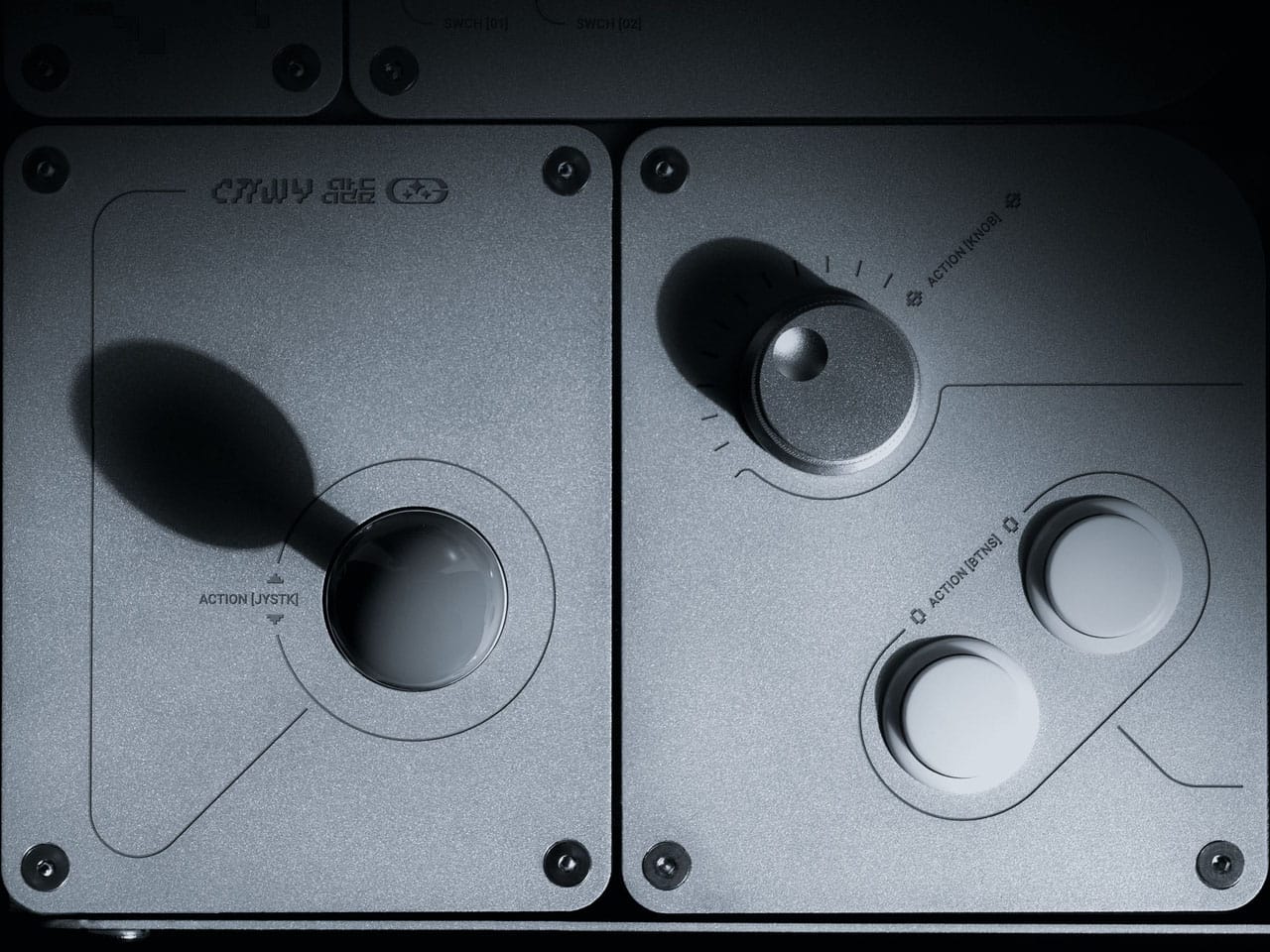
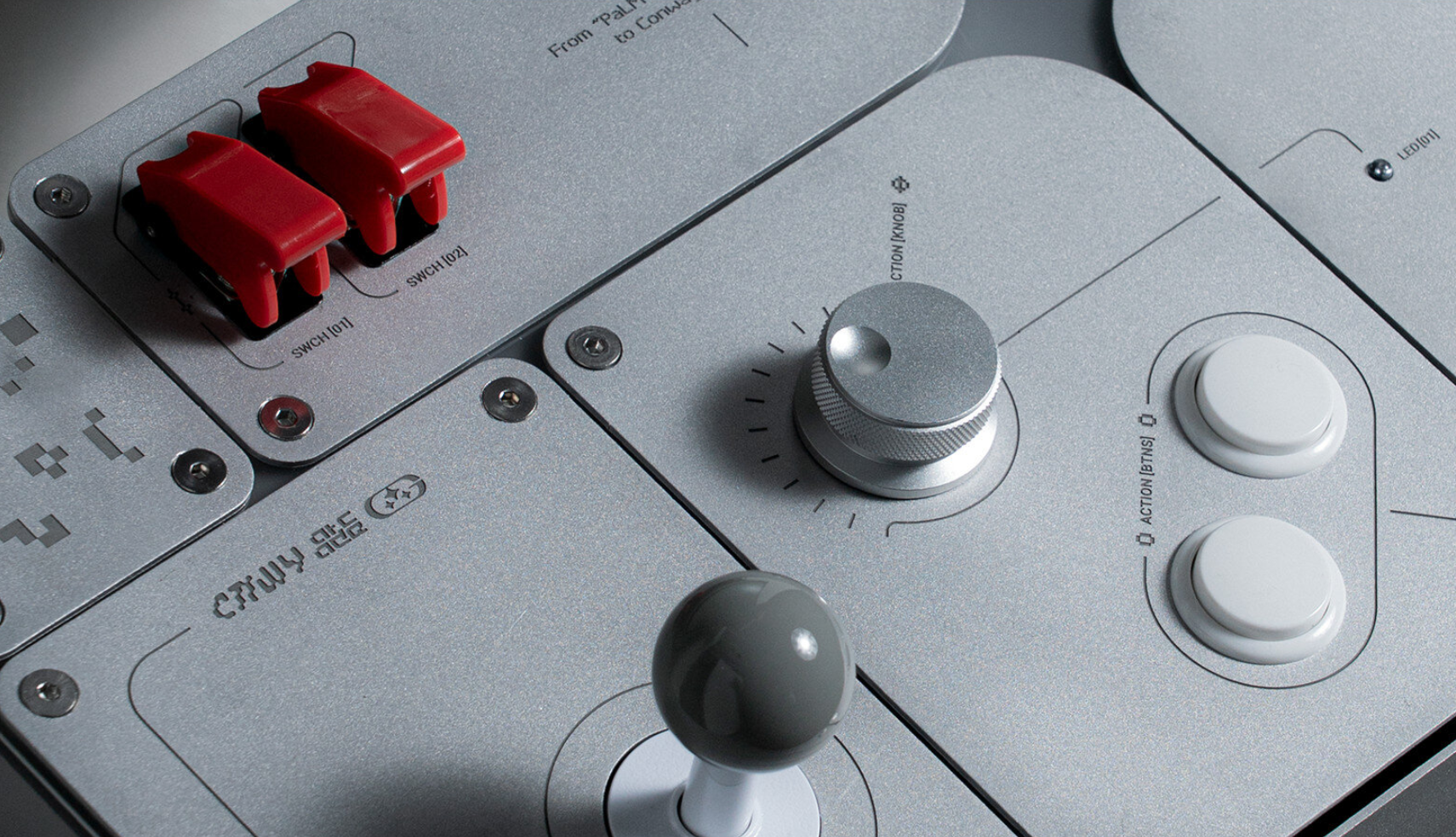
The interface follows established conventions: joystick and mechanical buttons deliver immediate tactile response. The physical structure remains constant across sessions; what changes is the on-screen configuration. This separation between stable hardware and variable software underscores the project’s focus on generative systems. Installed within a research conference environment, the cabinet functioned as a playable demonstration rather than a commercial product. Instead of presenting computational models through diagrams or dashboards, the system was accessed through embodied interaction. Participants engaged with rule-based behavior directly, encountering generative logic as a playable system rather than an abstract concept.
AI-Powered Conway’s Arcade does not introduce a new arcade genre. It repositions the arcade machine as a container for real-time generative computation. By situating rule-based systems inside a familiar hardware typology, the project makes computational emergence observable through play—turning abstract logic into something tactile, visible, and testable.