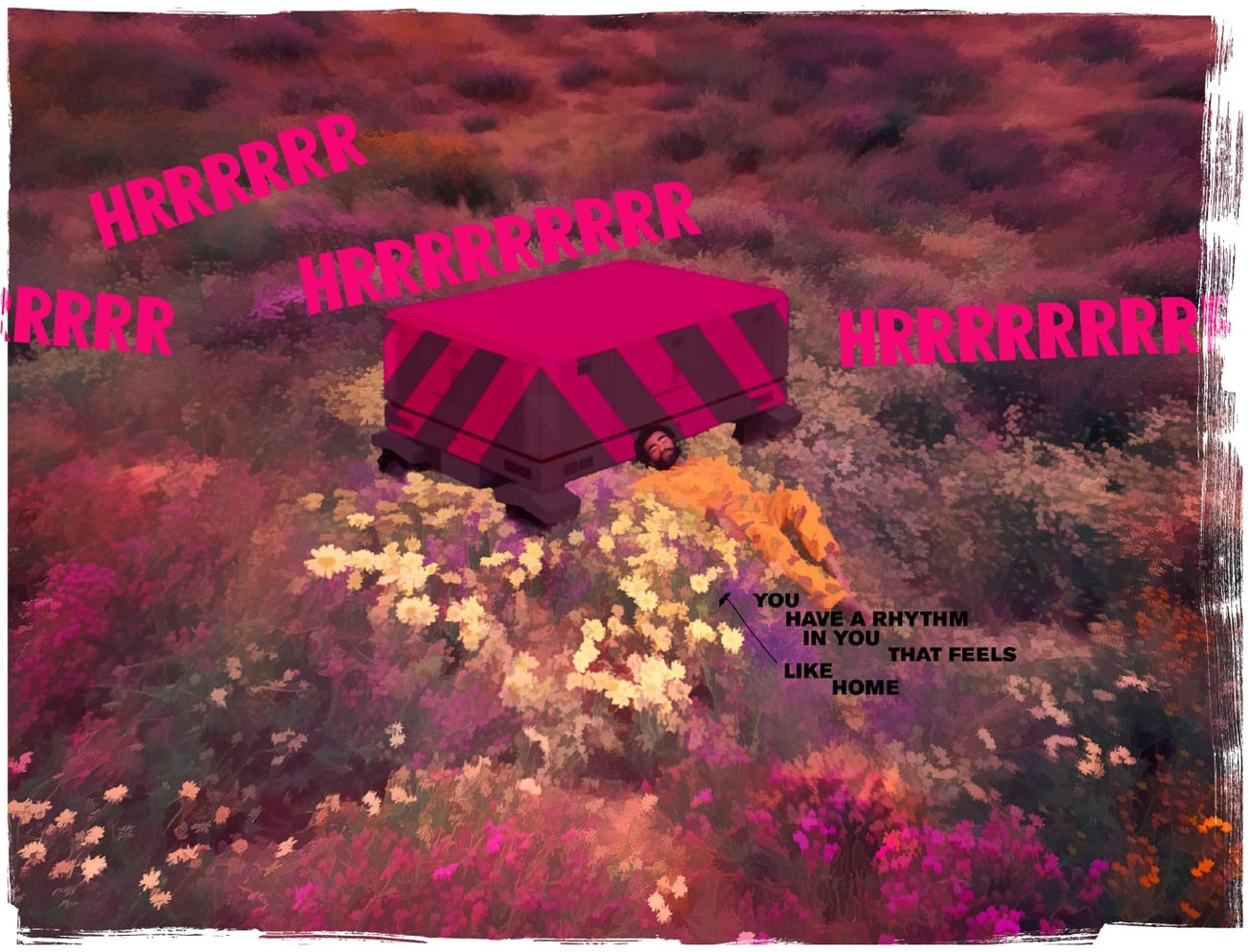
At ArtScience Museum, The Drone Shepherd extends Liam Young’s long-running investigation into planetary systems, automation, and environmental governance. Presented as a VR graphic novel, the work reframes Young’s speculative project Planet City through a tighter narrative lens—one focused less on the scale of the city than on the mechanisms that manage it. Rather than presenting technological salvation or dystopian collapse, the work constructs an encounter with how control, care, and infrastructure converge at planetary scale.
Young’s practice has consistently treated architecture as a medium for storytelling about systems rather than buildings. The Drone Shepherd continues that trajectory, using immersive media to render abstract processes—ecological monitoring, autonomous decision-making, remote stewardship—into spatially legible scenes. The work is speculative, but its materials are familiar: drones, sensors, automated oversight, and data-driven management. What changes is how these elements are arranged and experienced.
From Planet City to the Operational Layer
Planet City proposed a radical spatial consolidation: all humans living in a single hyper-dense metropolis to allow the rest of the planet to recover. The Drone Shepherd does not revisit that premise directly. Instead, it occupies the operational layer beneath it—the everyday systems required to make such a world function. The VR narrative unfolds in fragments, presenting landscapes shaped by drone surveillance and automated environmental control.
This shift in focus is subtle but consequential. Rather than debating the feasibility of a planetary city, the work examines the logic that governs its aftermath. Drones patrol rewilded zones, manage ecological thresholds, and enforce boundaries. The environment is no longer untouched nature nor traditional urban space, but a managed terrain optimized through continuous monitoring. The viewer’s position inside the work reinforces this emphasis. You are not an external observer assessing a master plan. You move through scenes that suggest procedures rather than places, encountering infrastructure as lived condition. The speculative question becomes procedural rather than monumental: what does planetary care look like when it is executed by autonomous systems?
Graphic Novel Logic in Virtual Space
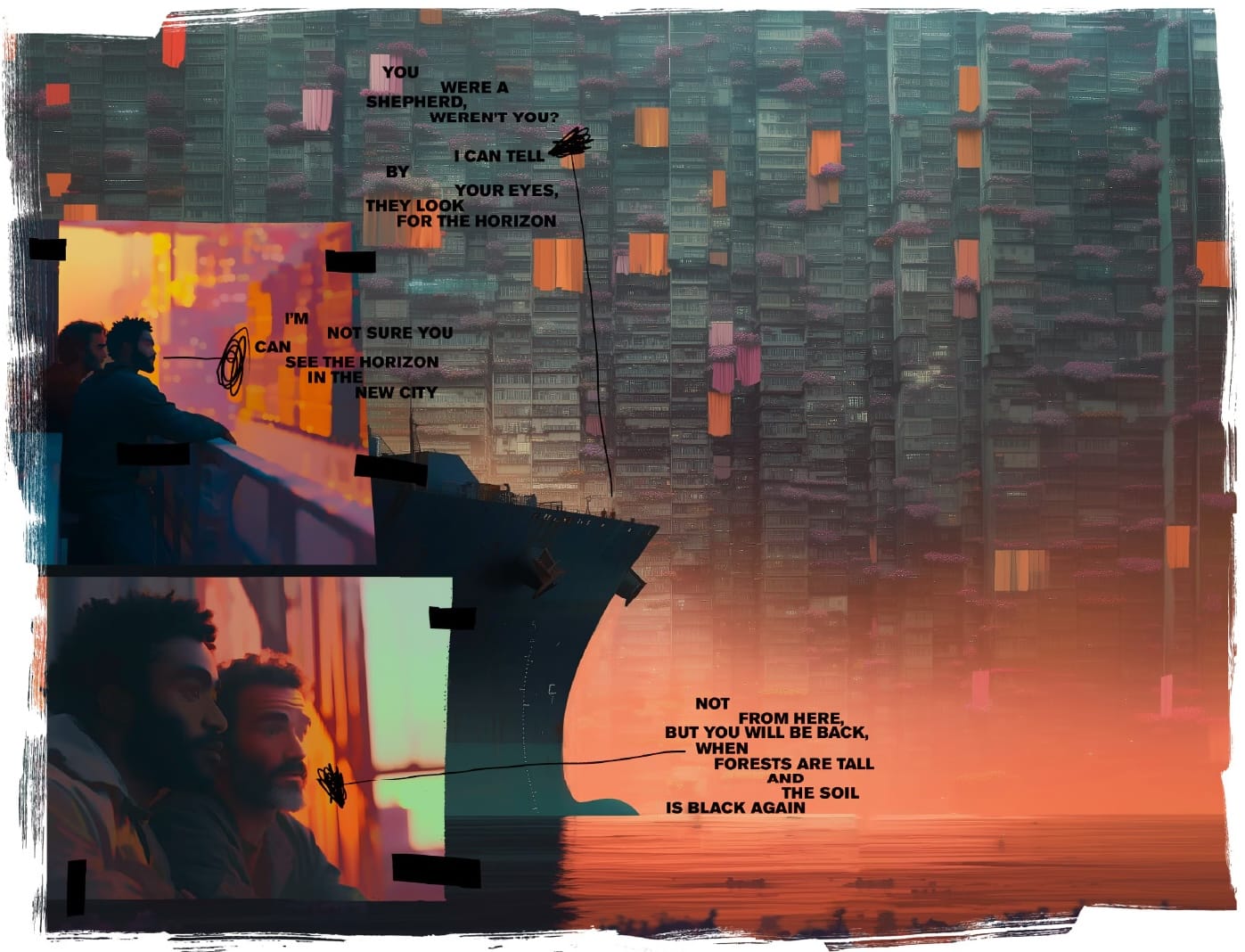
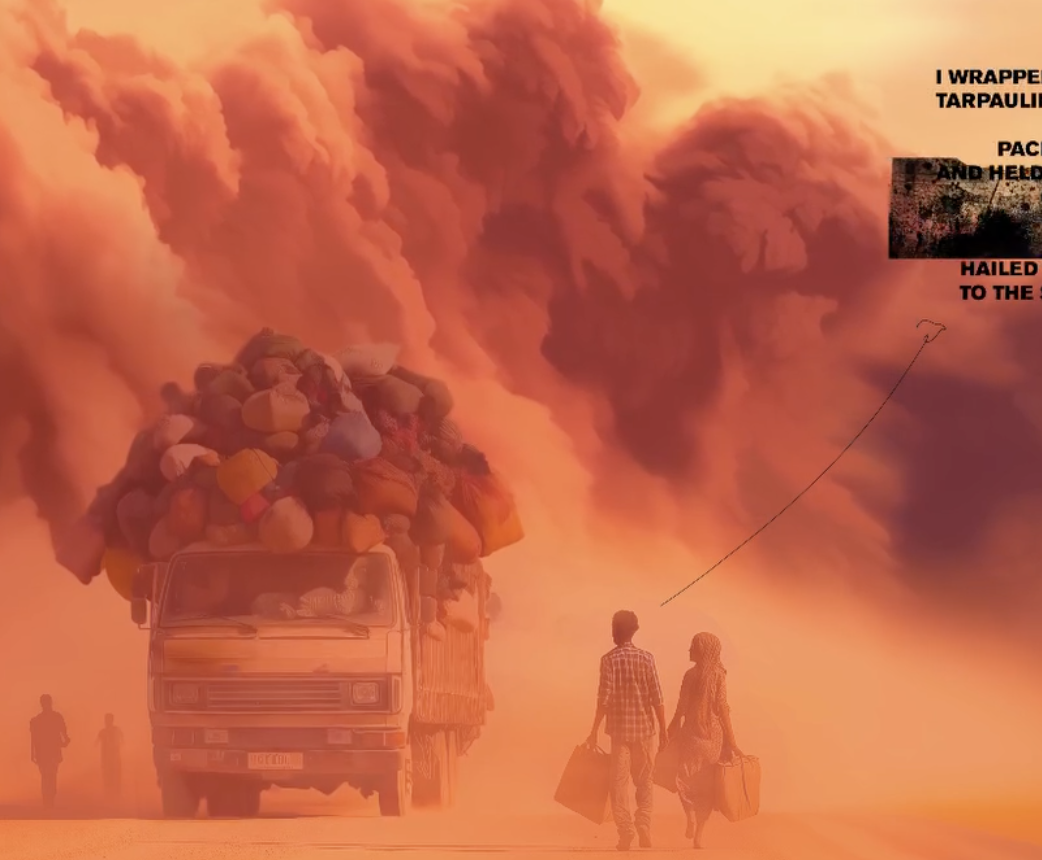
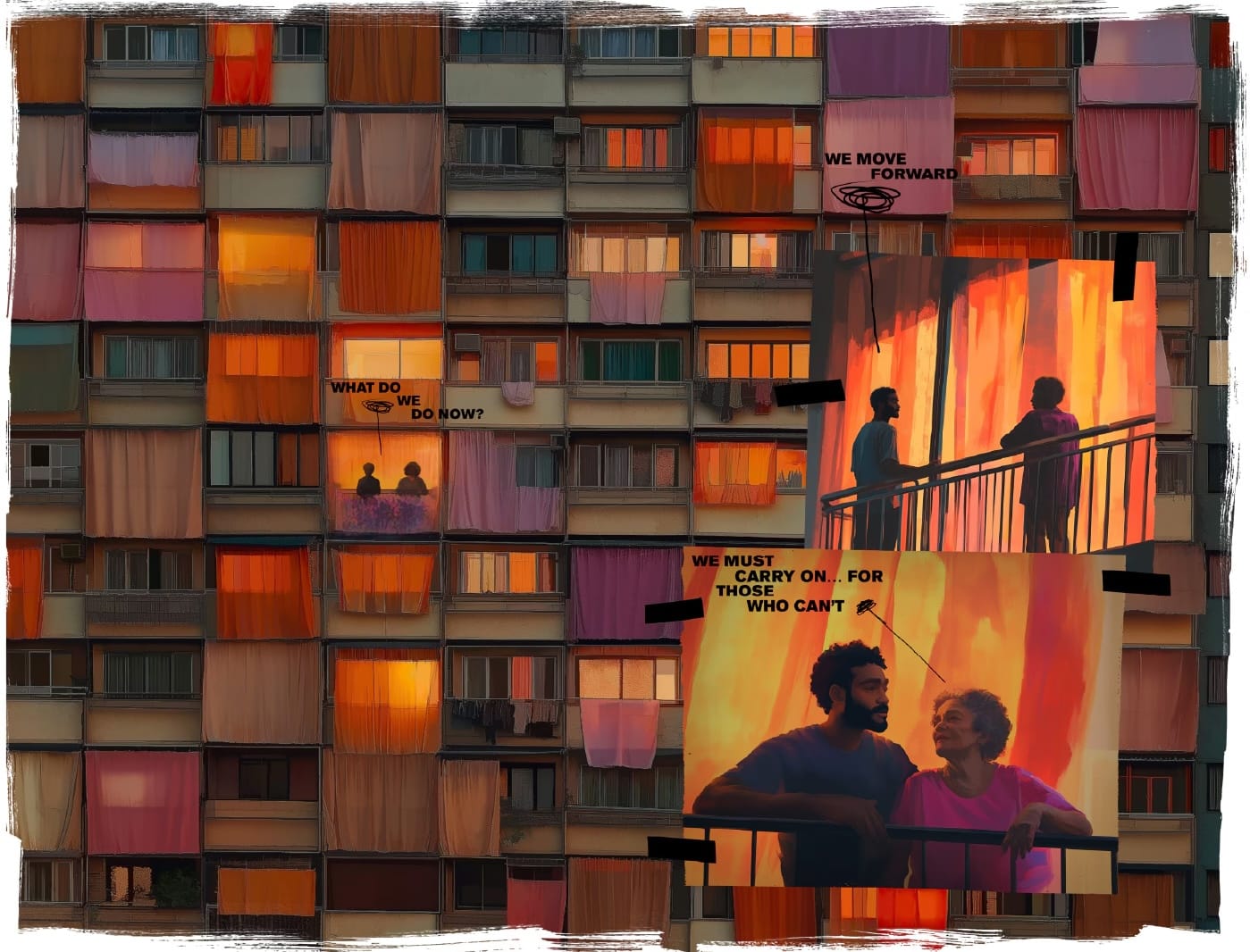
Formally, The Drone Shepherd resists the dominant aesthetic of VR as photoreal simulation. Young adopts the visual grammar of graphic novels—bold line work, flattened depth, and segmented compositions—translated into three-dimensional space. Scenes read as panels you inhabit rather than worlds you explore freely. By avoiding realism, the work foregrounds interpretation over immersion. The work encourages the reading of systems rather than the simulation of reality. Movement is deliberate, narrative pacing controlled, and visual density calibrated to guide attention rather than overwhelm it.
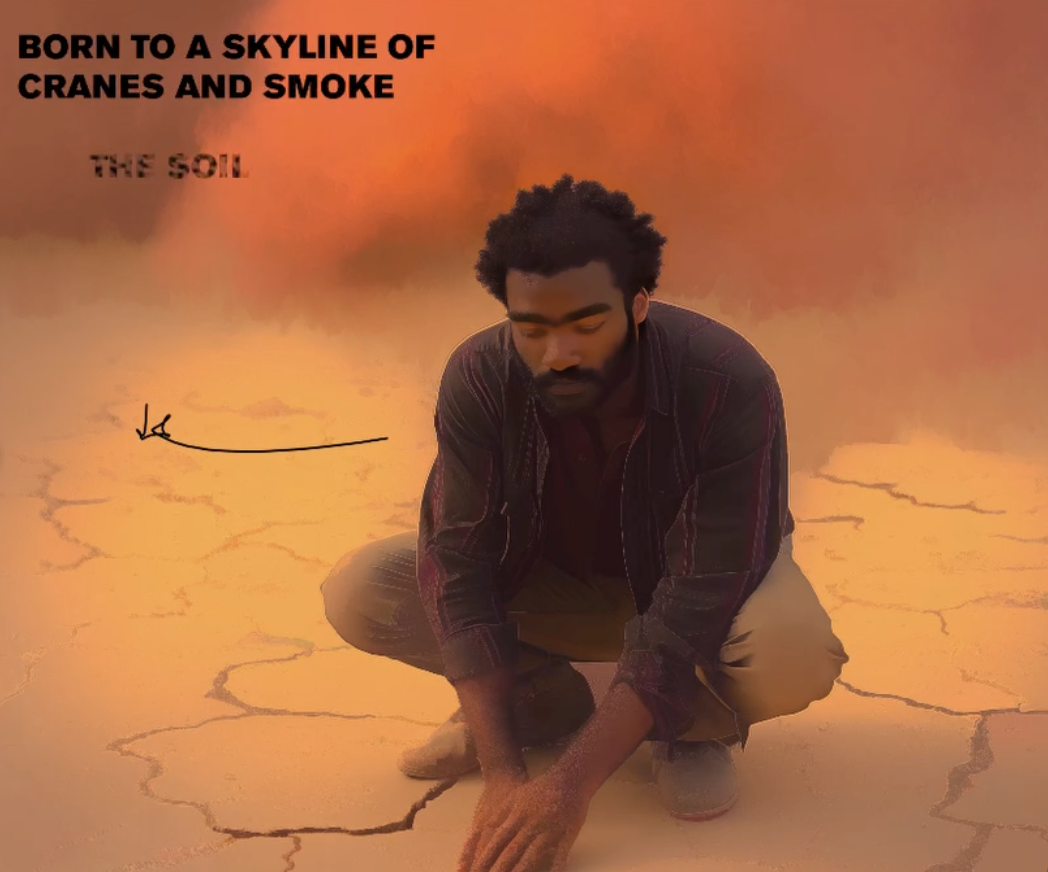
VR here functions as an interface for systems thinking. The medium is used to spatialize relationships—between drones and territory, governance and ecology—without collapsing into spectacle. The experience feels closer to navigating a spatial essay than inhabiting a virtual environment, aligning with Young’s broader interest in architecture as a narrative and critical tool.
Automation as Environmental Stewardship
The figure of the “shepherd” is deliberately ambiguous. In The Drone Shepherd, care is distributed across autonomous agents that monitor, decide, and intervene without human presence. Environmental stewardship is rendered as a continuous, automated process—less a moral choice than an operational mandate. This framing echoes contemporary developments in climate technology: AI-driven monitoring systems, automated conservation efforts, and remote sensing platforms designed to manage ecological risk. Young’s work does not dramatize these technologies as villains or saviors. Instead, it presents their logic as infrastructural fact.
Scenes emphasize thresholds, boundaries, and maintenance rather than growth or progress. The environment appears stabilized but tightly regulated. Life persists, but within parameters defined elsewhere. The viewer encounters a world where governance is embedded in code and logistics, operating persistently and quietly. The political tension emerges through accumulation rather than declaration. As scenes unfold, it becomes clear that planetary repair, when delegated to machines, also redefines agency. Decisions are made continuously, while deliberative processes remain largely invisible. The work invites viewers to notice this absence rather than resolving it.
Speculation as Design Method
The Drone Shepherd functions as a case study in how speculative practice can interrogate real systems without proposing solutions. The project does not offer a model to adopt or reject. It constructs a scenario precise enough to feel operational, yet open enough to remain contested.
Presented within ArtScience Museum’s programmatic focus on intersections between art, science, and technology, the work is notable for its restraint. There are no dashboards, no interactive controls, no invitation to optimize the system. The viewer’s role is interpretive, not managerial. This choice aligns with a growing recognition that design’s influence increasingly operates at the level of infrastructure. Decisions about automation, thresholds, and governance are rarely visible in finished artifacts, yet they shape behavior and possibility at scale. The Drone Shepherd makes these decisions spatially perceptible without foregrounding aesthetic spectacle. Young’s use of VR and graphic narrative demonstrates how emerging media can support critical design inquiry rather than dilute it. By translating planetary governance into a sequence of inhabitable scenes, the work reframes speculation as a method for examining power embedded in systems.
The Drone Shepherd does not predict a future. It constructs a lens through which existing trajectories—automation, environmental management, infrastructural governance—can be examined with clarity. Its value lies in this precision: a reminder that the most consequential design work often unfolds quietly, embedded in the systems that decide how worlds are maintained.